click to reduce image
click to enlarge image
Samarium Cobalt (SmCo) magnets are made by a sintering process and exist in two forms. The first is Sm1Co5 (SmCo 1:5) and this has a maximum energy product of between 18 and 22 MGOe. The second, and more common, form is Sm2Co17 (SmCo 2:17) and this has a maximum energy product of between 22 and 30 MGOe. The main SmCo alloy is around 35% Samarium (Sm) and 60% Cobalt (Co) with the balance being from varying amounts of Iron (Fe), Copper (Cu), Hafnium (Hf) and Zirconium (Zr). Praseodymium (Pr) may also be used.
Samarium Cobalt is also known as SmCo, Rare Earth Cobalt, RE Cobalt, RECo and CoSm.
Samarium Cobalt (SmCo) magnets are not as strong as the Neodymium (NdFeB) magnets (maximum energy product of between 30 and 50 MGOe) but they have three significant advantages. The SmCo magnets work over a wider temperature range, have superior temperature coefficients and have much greater corrosion resistance.
Samarium Cobalt (SmCo) magnets can be used at temperatures up to 350 degrees C. Neodymium magnets can be used at temperatures up to 200 degrees C. The SmCo magnets start to outperform the NdFeB magnets around 150-180 degrees C. Also, Samarium Cobalt magnets are ideal for very low temperature applications (SmCo can be used down to a few Kelvin above Absolute Zero) making them a first choice magnet for cryogenic applications.
The flux output of the Samarium Cobalt (SmCo) magnets is more stable with changes in temperature than NdFeB magnets due to having better temperature coefficients (e.g. -0.030%/°C for change in Br versus -0.100%/°C for NdFeB and -0.20%/°C for change in Hci versus -0.60%/°C for NdFeB). This can be particularly useful in critical applications such as sensors (although Alnico can be a better choice for temperature stability). It also means that Samarium Cobalt can resist demagnetisation better than Neodymium in higher temperature applications such as motors.
Samarium Cobalt (SmCo) magnets contain less free iron than Neodymium magnets and therefore provide better corrosion resistance than Neodymium magnets. It is very rare for SmCo magnets to require protective plating (a notable exception is the use of nickel plating for soldering the magnets to printed circuit boards).
These characteristics therefore make Samarium Cobalt (SmCo) suitable for applications such as pump couplings, sensors, loudspeakers, generators, guitar pick-ups, motors, sump plugs, high temperature applications, wide temperature range applications and for use in corrosive (e.g. water, oil) environments, marine applications, automotive, aerospace and military applications.
We offer bespoke sintered SmCo magnets. Standard magnet tolerances are +/-0.1mm with +/-0.05mm available for slightly higher cost. We can also produce the SmCo magnets with tolerances down towards +/-0.005mm as part of our Precision Magnets range although we will specify the tolerances that can be achieved for each shape (the Precision Magnets range is limited to small sized magnets and also to 100k minimum order quantity).
We supply Samarium Cobalt (SmCo) magnets with Maximum Energy Products (BHmax) varying from 18 MGOe up to 32 MGOe (our standard is 26 MGOe which we call SmCo26). In addition, we offer a range of SmCo with increased Hci to standard SmCo. We also supply Low Temperature Coefficient SmCo22LTC which has smaller variations in magnetic output with temperature than standard SmCo.
Bonded and Plastic bonded Samarium Cobalt is also available. Tooling charges may apply for these products (these products are made to order only and are best suited for higher volume production runs).
Please contact us for a datasheet on our sintered and bonded Samarium Cobalt (SmCo) magnets.
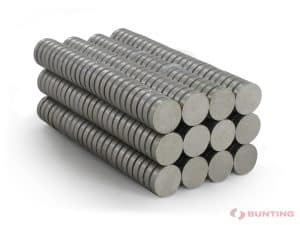
SmCo Disc Magnets
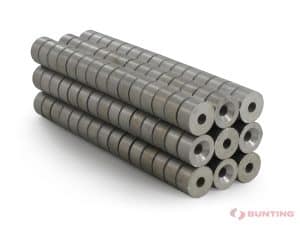
SmCo Discs with Central Holes
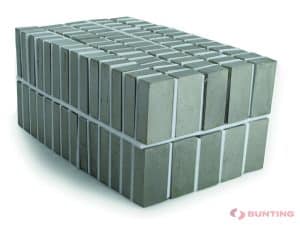
SmCo Rectangular Magnets
Precision SmCo Magnets
Copyright © e-Magnets UK
Company Registration Number 6515204
Samson Works, Blagden Street, Sheffield, S2 5QT
Magnets | Types of Magnets | On-Line Shop | Contact Us
Please ensure you have read our Terms & Conditions prior to using this website.